


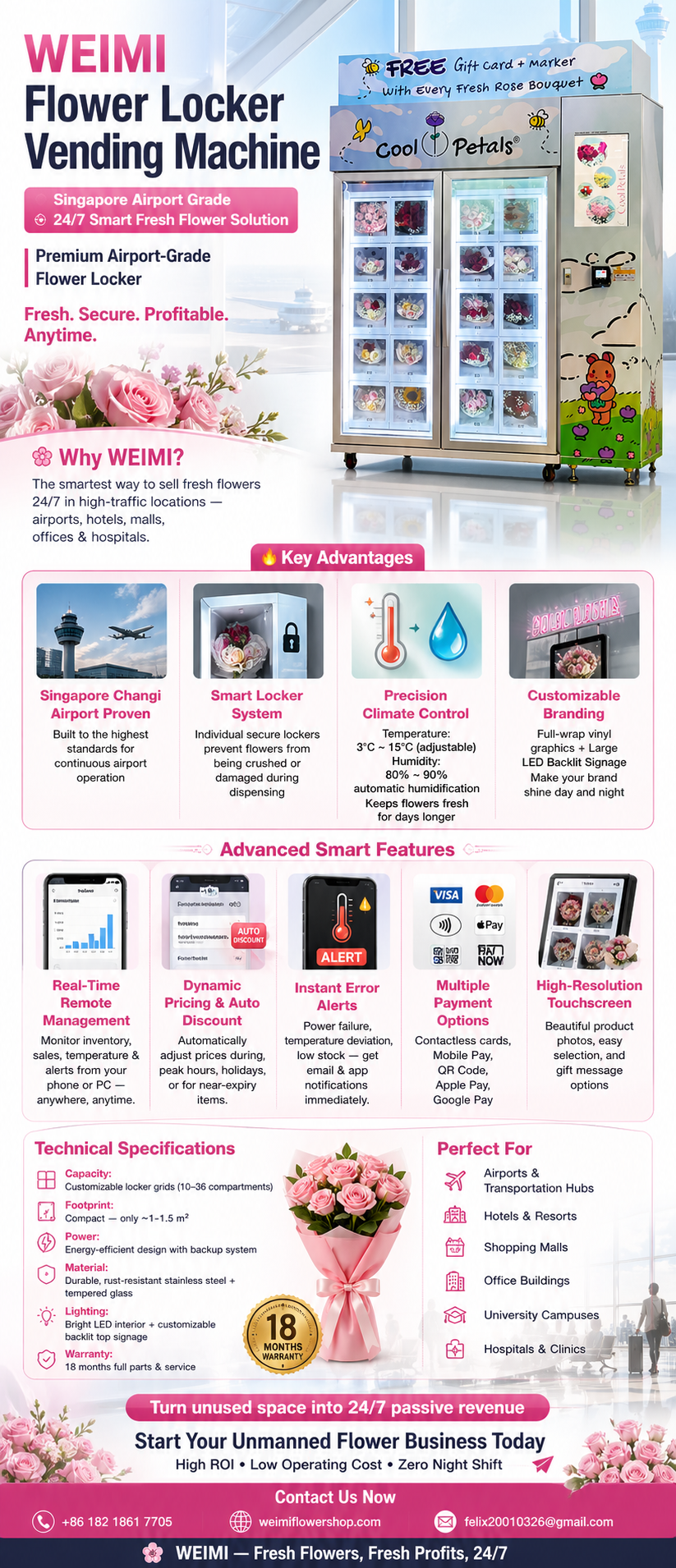
Revenue access
Extend selling availability beyond staffed hours and place inventory closer to demand.
Commercial fit
Prioritizes fast customer flow, strong merchandising visibility and operational access in demanding commercial locations.
Extend selling availability beyond staffed hours and place inventory closer to demand.
Separate customer transactions from replenishment so teams can operate a planned service route.
Coordinate assortment, price architecture, display content and approved brand presentation.
Use configured cloud functions to review sales, inventory and machine status across locations.
System architecture
Final functions depend on selected hardware, software, payment market and project scope.
Layer 01
Confirm bouquet dimensions, target storage settings, airflow approach, glazing, lighting and replenishment workflow for the intended assortment.

Layer 02
Align the display, product information, language, payment terminal and collection method with customer expectations in the destination market.

Layer 03
Selected platform functions can support remote sales review, stock visibility, pricing, content, temperature settings, device status and alerts.

Layer 04
Define exterior graphics, logo treatment, interface language, payment hardware, compartment layout and other project-specific options before production.
Published product data
Use the data below as a starting point. Final dimensions, electrical, cooling, payment and compliance requirements must be confirmed in the project quotation.

Deployment workflow
A structured sequence reduces configuration gaps and site-readiness delays.
Market, venue, assortment, quantity and commercial objectives.
Capacity, environment, payment, software, branding and compliance inputs.
Configuration, quotation, drawings, responsibilities and schedule.
Manufacturing, agreed checks, export packing and shipping coordination.
Site setup, team workflow, performance review and rollout decisions.
Buyer checklist
Share the country, venue type, placement, opening hours, service access and whether the project is direct operation, distribution or venue partnership.
Provide bouquet dimensions, assortment tiers, estimated daily volume, target replenishment frequency and any non-floral categories.
List required payment methods, languages, connectivity, cloud users, reporting needs and any integration expectations.
Confirm quantity, preferred branding, destination, target timing and available site utilities. The project team can then identify open decisions.
Product launch playbook
Prioritize queue-free transactions, strong visibility, replenishment windows and venue approvals.
Define who buys, why they buy, when demand peaks and which price tiers need to be available.
Review placement, sightlines, floor footprint, utilities, access control and customer dwell time.
Translate bouquet or product dimensions into compartment count, turnover and freshness-control rules.
Confirm payment methods, language, product information, promotions and customer handoff steps.
Set replenishment frequency, cleaning, freshness checks, exception handling and spare-parts ownership.
Choose pilot KPIs, review dates, network standards and the decision rules for the next site.
Media and proof board
Review the installed system, customer interface and equipment details in the published product media.
State the intended venue, buyer role, quantity, target launch and operating objective.
Confirm footprint, power, connectivity, cooling, capacity, payment hardware and user interface scope.
Align configuration approval, production, inspection, packaging, shipping terms and site readiness.
Assign training, remote assistance, maintenance, spare parts, escalation and local service ownership.
Planning resources
Use the venue, site and fleet guides to turn product interest into an operating brief.
Review customer flow, site constraints, commercial terms and service access for the intended venue.
Open the venue guide → Location strategyCompare traffic quality, buyer occasions, visibility, utilities, rent and replenishment access.
Read the site framework → Fleet operationsPlan inventory visibility, temperature alerts, sales reporting and multi-location user access.
Read the operator guide →Configuration checkpoint
A useful quotation connects the selected machine to venue conditions, bouquet dimensions, payment requirements and delivery ownership.
Indoor or protected outdoor conditions, footprint, access, utilities and ambient range.
Define the environmentBouquet dimensions, price tiers, cell mix, cooling strategy and replenishment frequency.
Match the assortmentInterface language, payment provider, transaction flow, pickup and accessibility needs.
Confirm integrationsApprovals, quantity, destination, packaging, launch timing, training and spare parts.
Plan deploymentMachine architecture, refrigeration, payment hardware, software scope, customization, order quantity, destination and trade terms are confirmed together.
Provide venue type, installation environment, bouquet sizes, quantity, payment methods, branding needs and target launch date.
Commercial inquiry
Provide the destination market, venue type, quantity and required integrations. A WEIMI project specialist will review system fit and quotation requirements.
Project brief builder
Select the commercial context first. Your choices stay in this browser until you add them to the inquiry; nothing is sent before form submission.
Inquiry context: Product — Singapore Airport Grade Smart Flower Vending Machine | Customizable Brand Graphics & LED Backlit Signage
Review and edit the message before submitting.