


Revenue access
Extend selling availability beyond staffed hours and place inventory closer to demand.
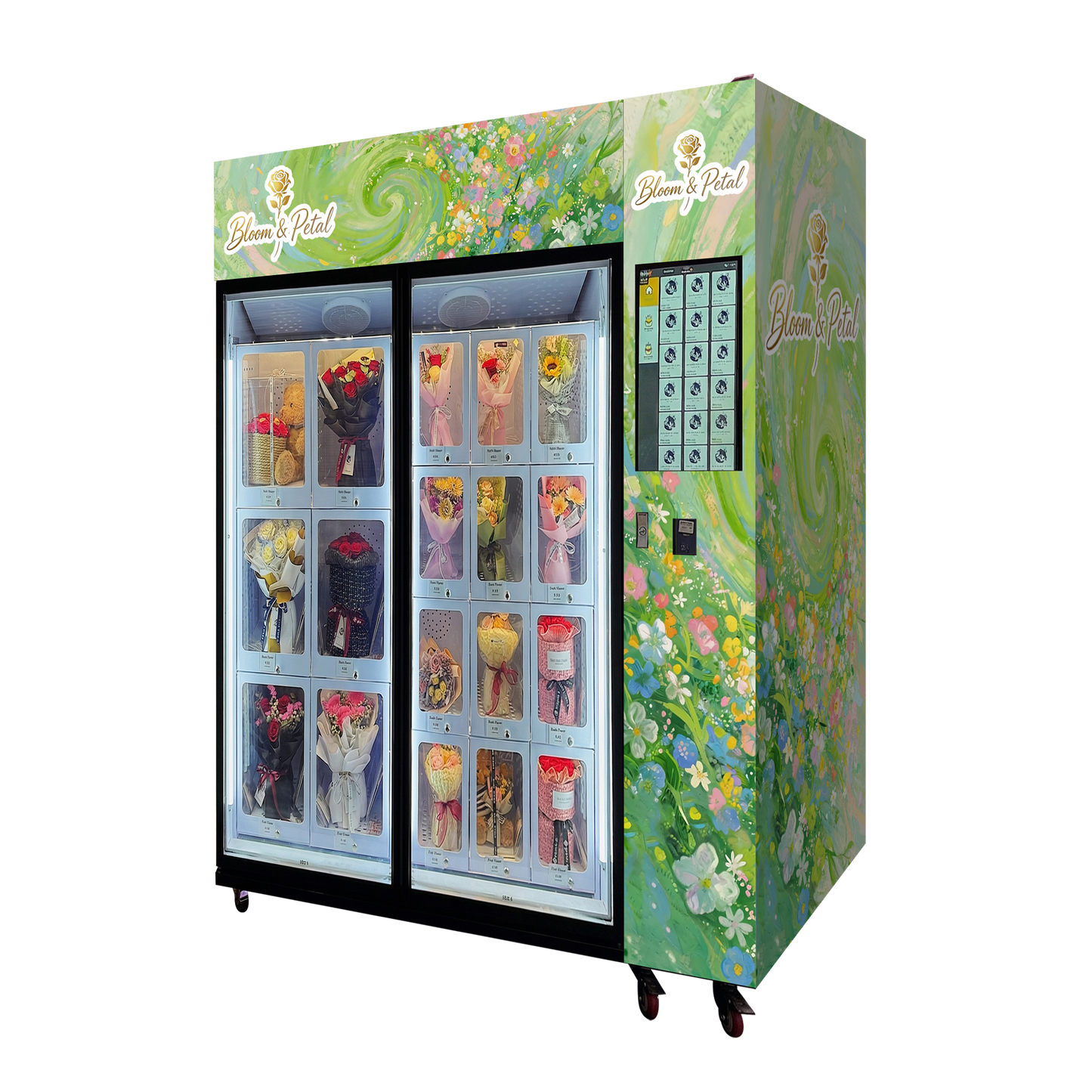
WM-RL18 / Product showroom
Specify storage for the actual flowers and wrapping, with loading checks and ageing-stock removal.

Multi-angle product photography. Images illustrate the pictured configuration; final equipment follows the approved drawing. These photographs are not a continuous 360° spin or structural drawing.
14-point engineering review
Reference values are distinguished from project decisions. Unverified figures are not treated as certified equipment data.
| Engineering item | Reference / requirement | Basis / next step |
|---|---|---|
| Model / catalogue reference | WM-RL18 | Listing identifier |
| Cabinet architecture | Refrigerated bouquet lockers | Configuration brief |
| Placement / environment | Controlled retail environment; confirm site | Site review required |
| External dimensions (W × D × H) | Confirm on model-specific drawing | Drawing required |
| Compartment / assortment plan | Bouquet layout and capacity to confirm | Final layout required |
| Usable bouquet clearance | Confirm finished wrapping and usable opening | Drawing + fit test required |
| Temperature / storage conditions | Agree for the selected flowers and site | Configuration required |
| Refrigeration / refrigerant | Confirm refrigerant, cooling unit and climate limits | Signed specification required |
| Display / customer interface | Interface specification to confirm | Panel specification required |
| Control system / memory | Confirm controller and software version | Configuration required |
| Connectivity | Confirm available network and local compatibility | Configuration required |
| Access / collection | Confirm customer and service access workflow | Workflow sign-off required |
| Payment / transaction scope | Select local provider, terminal and supported methods | Market/provider approval required |
| Electrical / installation | Confirm voltage, frequency, rated load and service clearances | Electrical + site drawing required |
This model-specific configuration brief is not a signed engineering specification. Listing identifiers and format descriptions do not establish ratings, certifications, exact dimensions or performance. Obtain the approved drawing and quotation before ordering.
WM-RL18 / OEM & ODM brief
Compartment mix, branding and storage requirements. Availability, development scope and costs are confirmed in the quotation.
Discuss customizationSend finished bouquet dimensions, wrapping photos, storage requirements and the intended refill interval.
Confirm country, venue, power, network, languages and preferred payment provider.
Review the model drawing, artwork, software scope, test criteria and commercial quotation.
Product details
Review the product configuration, then confirm the ordered model and usable bouquet space in your quotation.
Model: WEIMI WM-RL18 • Floral Freshness Preservation Series
Engineered for premium florists, botanical designers, hospital lobbies, and upscale gift concourses where floral presentation and extended vase life are paramount. The WM-RL18 creates a clinical-grade postharvest microclimate that slows cellular respiration without chilling injury. Equipped with an 18-compartment layout (3 columns × 6 tiers), microprocessor-controlled Embraco R290 inverter refrigeration (2°C–6°C with ±0.3°C PID accuracy), passive ultrasonic micro-mist humidity diffusion (85%–92% non-wetting RH), and integrated potassium permanganate (KMnO4) catalytic ethylene scrubbing, it keeps high-margin arrangements fresh for 7 to 10 days.
| Model Identifier | WEIMI WM-RL18 (Freshness Preservation Edition) |
|---|---|
| Cabinet Construction | 1.5mm Electro-Galvanized SPCC Steel with Anti-Bacterial Internal Coating |
| Locker Compartments | 18 Independent Showcase Bays (3 Columns × 6 Tiers Architecture) |
| Locker Bay Dimensions | 340mm (W) × 560mm (H) × 360mm (D) (Supports Conical Sleeves & Tall Glass Vases) |
| Thermal Architecture | 2°C to 6°C Precision Cold Chain (PID Calibration ±0.3°C) |
| Humidity Management | 85% to 92% Relative Humidity Passive Micro-Vapor Retention (Non-Wetting) |
| Refrigeration Unit | Embraco Inverter Compressor • Eco R290 Hydrocarbon |
| Ethylene Mitigation | Replaceable KMnO4 Potassium Permanganate Catalytic Scrubbing Core |
| Glazing Specification | Double-Glazed Heated Low-E Tempered Glass (ITO Electric Defrosting Wire) |
| Illumination System | Warm Neutral 3500K Botanical CRI >95 LED Diffused Strips |
| Payment Architecture | Nayax VPOS Touch / PAX D200 (EMV Chip, Contactless NFC, Apple Pay, Google Pay, QR) |
| Control Console | 10.1" / 21.5" Sunlight-Readable Industrial Capacitive Touchscreen |
| Dimensions & Weight | 1,580 mm (W) × 720 mm (D) × 1,980 mm (H); Operating Weight: ~320 kg |
| Certifications | CE, FCC, RoHS, ISO9001 Commercial Manufacturing Standards |
Download the WEIMI Commercial Flower Vending Catalogue (PDF).
Compare all commercial flower machine specifications & bouquet fit guidelines.
Request direct factory quotation, custom dimensions, and ocean container rates.
Commercial fit
Balances bouquet presentation, controlled storage and self-service access for extended-hour floral sales.
Extend selling availability beyond staffed hours and place inventory closer to demand.
Separate customer transactions from replenishment so teams can operate a planned service route.
Coordinate assortment, price architecture, display content and approved brand presentation.
Use configured cloud functions to review sales, inventory and machine status across locations.
System architecture
Final functions depend on selected hardware, software, payment market and project scope.
Layer 01
Confirm bouquet dimensions, target storage settings, airflow approach, glazing, lighting and replenishment workflow for the intended assortment.

Layer 02
Align the display, product information, language, payment terminal and collection method with customer expectations in the destination market.

Layer 03
Selected platform functions can support remote sales review, stock visibility, pricing, content, temperature settings, device status and alerts.

Layer 04
Define exterior graphics, logo treatment, interface language, payment hardware, compartment layout and other project-specific options before production.

Deployment workflow
A structured sequence reduces configuration gaps and site-readiness delays.
Market, venue, assortment, quantity and commercial objectives.
Capacity, environment, payment, software, branding and compliance inputs.
Configuration, quotation, drawings, responsibilities and schedule.
Manufacturing, agreed checks, export packing and shipping coordination.
Site setup, team workflow, performance review and rollout decisions.
Buyer checklist
Share the country, venue type, placement, opening hours, service access and whether the project is direct operation, distribution or venue partnership.
Provide bouquet dimensions, assortment tiers, estimated daily volume, target replenishment frequency and any non-floral categories.
List required payment methods, languages, connectivity, cloud users, reporting needs and any integration expectations.
Confirm quantity, preferred branding, destination, target timing and available site utilities. The project team can then identify open decisions.
Product launch playbook
Confirm order allocation, code retrieval, cell dimensions and handoff responsibility.
Define who buys, why they buy, when demand peaks and which price tiers need to be available.
Review placement, sightlines, floor footprint, utilities, access control and customer dwell time.
Translate bouquet or product dimensions into compartment count, turnover and freshness-control rules.
Confirm payment methods, language, product information, promotions and customer handoff steps.
Set replenishment frequency, cleaning, freshness checks, exception handling and spare-parts ownership.
Choose pilot KPIs, review dates, network standards and the decision rules for the next site.
Media and proof board
Review the installed system, customer interface and equipment details in the published product media.
State the intended venue, buyer role, quantity, target launch and operating objective.
Confirm footprint, power, connectivity, cooling, capacity, payment hardware and user interface scope.
Align configuration approval, production, inspection, packaging, shipping terms and site readiness.
Assign training, remote assistance, maintenance, spare parts, escalation and local service ownership.
Planning resources
Use the venue, site and fleet guides to turn product interest into an operating brief.
Review customer flow, site constraints, commercial terms and service access for the intended venue.
Open the venue guide → Location strategyCompare traffic quality, buyer occasions, visibility, utilities, rent and replenishment access.
Read the site framework → Fleet operationsPlan inventory visibility, temperature alerts, sales reporting and multi-location user access.
Read the operator guide →Configuration checkpoint
A useful quotation connects the selected machine to venue conditions, bouquet dimensions, payment requirements and delivery ownership.
Indoor or protected outdoor conditions, footprint, access, utilities and ambient range.
Define the environmentBouquet dimensions, price tiers, cell mix, cooling strategy and replenishment frequency.
Match the assortmentInterface language, payment provider, transaction flow, pickup and accessibility needs.
Confirm integrationsApprovals, quantity, destination, packaging, launch timing, training and spare parts.
Plan deploymentMachine architecture, refrigeration, payment hardware, software scope, customization, order quantity, destination and trade terms are confirmed together.
Provide venue type, installation environment, bouquet sizes, quantity, payment methods, branding needs and target launch date.
Commercial inquiry
Provide the destination market, venue type, quantity and required integrations. A WEIMI project specialist will review system fit and quotation requirements.